Update Statistics Sql Server 2008 All Tables
Statistics are one of the most important factors of a database as it contains information about how data is distributed in the database objects (tables, indexes etc). It is quite common to listen people talking about not optimal plan and expired statistics. Quite often I have heard the suggestion to update the statistics if query is not optimal. Please note that there are many other factors for query to not perform well; expired statistics are one of them for sure. If you want to know when your statistics was last updated, you can run the following query.
USE AdventureWorks GO SELECT name AS indexname, STATSDATE(OBJECTID, indexid) AS StatsUpdated FROM sys.indexes WHERE OBJECTID = OBJECTID('HumanResources.Department') GO. If due to any reason you think that your statistics outdated and you want to update them, you can run following statement. In following statement, I have specified an additional option of FULLSCAN, which implies that the complete table is scanned to update the statistics. USE AdventureWorks; GO UPDATE STATISTICS HumanResources.Department WITH FULLSCAN GO Please note that you should only run update statistics if you think they will benefit your query and when your server is not very busy.
Pure America's Got Talent, Inside AGT: The Untold Stories of America’s Got Talent, America's Got Talent, America's Got Talent Alumni, Reality TV, TV. Inside AGT: The Untold Stories of America's Got Talent [Sean Daly, Ashley Majeski] on Amazon.com. *FREE* shipping on qualifying offers. Think you know everything. Inside AGT: The Untold Stories of America's Got Talent 4.9 out of 5 based on 0 ratings. 'Inside AGT: The Untold Stories of America's Got Talent' - Read An Exclusive Preview - Free download as PDF File (.pdf), Text File (.txt) or read online for free. Catfish the untold stories.
This article mentions Script to Update Statistics for all databases in SQL Server. SQL SERVER 2005 supports DBREINDEX but it will be deprecated in future versions. Let us learn how to do ReIndexing Database Tables and Update Statistics.
If you have auto update “usually” on, the SQL Server takes care of updating stats when necessary. Here, is a quick example where you can see the updating of older statistics using fullscan. Statistics is very deep subject, and a lot of things can be discussed over it. We will discuss about many other in-depth topics in some other article in future. Reference: Pinal Dave ( ). Pinal Dave is a SQL Server Performance Tuning Expert and an independent consultant. He has authored 11 SQL Server database books, 21 Pluralsight courses and has written over 4000 articles on the database technology on his blog at a Along with 16+ years of hands on experience he holds a Masters of Science degree and a number of database certifications.
For any send email at pinal@sqlauthority.com. Pinal is also a and.
Nupur Dave is a social media enthusiast and and an independent consultant.
I first knew something was up when I looked at the job history for a simple maintenance plan. It had two steps:. Rebuild all the indexes in the database – this took 10 minutes each night. Update statistics – this took 2-3 hours each night. What was going on? Are small, lightweight objects.
Are larger and contain more data. Why would updating statistics take so much longer? Maintenance Plans light the fuse I love the concept of maintenance plans, but I don’t love the way all the tasks are set up. In the case I was looking at, the Update Statistics task was being used with two values that are set by default:. Run against all statistics.
Update them with fullscan “All” statistics means that both “column” and “index” statistics will be updated. There may be quite a lot of statistics — most people leave the “auto create statistics” option enabled on their databases, which means that queries will dynamically cause the creation of more and more statistics over time. Combined with “fullscan”, updating all statistics can become a significant amount of work. “Fullscan” means that to update a statistic, SQL Server will scan 100% of the values in the index or column. That adds up to a lot of IO. Why ‘SELECT StatMan’ repeatedly scans tables If SQL Server needs to update column level statistics for the same table, it could potentially use a single scan and update multiple stats, right? Because of the runtimes I was seeing, I was pretty sure that wasn’t happening.
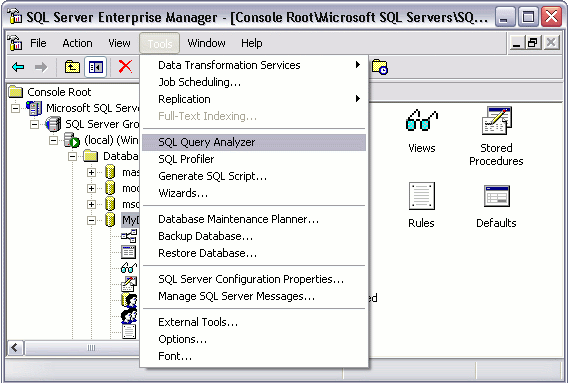
But we can take a closer look and see for ourselves. In our maintenance plan task, if we hit “View TSQL”, a window pops up showing us the comamnds that the plan will run. (I love this feature, by the way!) We will use one of these commands to test things out in a bit. First, let’s make sure we have some column level statistics on our database.
It already has indexes and their associated stats. To create some column level stats, I run these queries. AS MSUPDSTATSTBL OPTION ( MAXDOP 16 ) The “logicalreads” column lets me know that updating four of these statistics had to do four separate scans of my table– and three of them are all on the Title column! (Doing a SELECT. FROM Person.Person shows 5,664 logical reads by comparison.) IO was lower for statistics related to nonclustered indexes because those NC indexes have fewer pages than the clustered index. A better way to update statistics: Let SQL Server pick the TABLESAMPLE If you just run the TSQL command ‘UPDATE STATISTICS Person.Person’ (without telling it to scan all the rows), it has the option to do something like this.
OPTION ( MAXDOP 1 ) It dynamically figures out a sample size by which to calculate results! (It can pick a variety of options– including scanning the whole thing.) How to configure faster, better statistics maintenance Avoid falling for the pre-populated settings in the “Update Statistics” task in the maintenance plan. It’s rare to truly need to use FULLSCAN to update stats in SQL Server, and even when cases where it’s justified you want to implement that with statements targeting the individual statistics to update. The basic “UPDATE STATISTICS Schema.TableName” command is pretty clever– the issue is simply that Maintenance Plans don’t make it easy for you to run that!
Unfortunately, if you use maintenance plans there’s no super simple solution– it forces you to specify either fullscan or a specific sample. There’s no way to just use the basic “You compute the minimum sample” with that task. You’ve still got good options, they’re just a few more steps:. You could use a t-sql related task or a custom SQL Agent job to run.
You could use a. The example I’ve linked to is super clever, and avoids updating statistics where it has just rebuilt an index!. You could also let take care of the issue– that’s often just fine on small databases or where there aren’t major data fluctuations And each of those options should chew up less IO than updating all index and column statistics with FULLSCAN.
I actually had a strange performance issue result from stats being updated this morning – a job went from 44 minutes right after the update took place. First thought: developers deployed something 😉 After a little analysis and a new NC index, all was well. After that, however, I still wanted to find out what happened so I turned to my maintenance jobs. To investigate my index/stats maintenance history, I have a report I created to query Ola’s logging table if anyone is interested. Turns out the table I put an index on had it’s stats updated, obviously throwing the execution plan out of whack. You would have to update the data sources and parameter defaults, but that’s about it.
I’m not a huge fan of the Resample option. Let’s say someone’s troubleshooting an issue and they try updating statistics on an index with fullscan to see if it solves a problem.
It doesn’t solve the problem, but suddenly ‘resample’ is now being applied by maintenance repeatedly. And probably the person who was doing the test doesn’t even realize that they caused a change. If there are individual statistics which need a higher sample, I like to have an agent job update those specifically with documentation about what issues are corrected — because there’s always a chance that the queries they help won’t even be run in a few years. Appreciate your quick responses. I was weighting switching to handle the stats update using maintenance script vs my current DB setting which is set ON (assuming the auto update is interfering my OLTP/batch job perf.). We do have index maint. Jobs and fragmentation on tables are very low.
I’ve read articles showing that at fullscan, update statistics can run in parallel. We have a 4 TB database and my research indicated we would have to drop below 50% sample rate to get as much work done in a given time as fullscan. Over years of working with our developers on this application, we’ve concluded that sql server’s default sample rate ( very very low ) just wouldn’t work for us. We’ve been updating stats with fullscan for a few years now, and the only “downside” is seeing high IO in tempdb ( in particular ) during the maintenance window. But no blocking or deadlocks. Randy, I appreciate your input.
We’ve been using Ola’s index stats scripts for a while but have recently had some really bad situations with pegged CPU and horrible DB performance across the board. There was no degradation, just night and day crap performance on all queries. Microsoft had to be engaged and each time they asked me about stats I said sure we update them nightly(with the method Kendra mentions here).
And then they update them with a full scan (along with a few indexes which weren’t required the day before) and boom everything is back to normal. Once I saw your comment about their sample being too low I’m now suspicious of this as well. We may have to go to fullscan all the time too.
We use Ola Hallengren’s indexoptimize in a slightly customized way. Its limited to 3 hours on weeknight’s and certain huge indexes are excluded. Those are processed on Saturdays where it is limited to about 8 hours. In both windows I create a temp table of statistics that have been modified, ordered with highest modification ratio first AND ROUND(CAST(100.0.
sp.modificationcounter / sp.rows AS DECIMAL(18,2)),2).5 AND sp.rows50000 ORDER BY ROUND(CAST(100.0. sp.modificationcounter / sp.rows AS DECIMAL(18,2)),2) DESC,lastupdated Then indexOptimize is called for a single statistic in a cursor loop. @UpdateStatistics = ‘ALL’, @Indexes = @tablecommand, @OnlyModifiedStatistics = ‘Y’, @StatisticsSample= 100, @TimeLimit = 1800, @MaxDOP = 8, @LogToTable = ‘Y’, @delay=1. Thanks for the link!
I had gone through that page, but didn’t find TimeLimit in the list of parameters – turns out it is only documented by example G – “Rebuild or reorganize all indexes with fragmentation on all user databases, with a time limit so that no commands are executed after 3600 seconds”. Our database is a bit big and maintenance jobs without a stopping point will run into prime hours.
I’m hoping to engineer a method which will allow IndexOptimize to update statistics on a table by table basis pausing at the end of the maintenance window, then pick up again at the beginning of the next window where it stopped. I looked this up because I was seeing a large amount of CXPACKET waits during the update statistics window even though the MAXDOP in our environment is set to 1 (I know, don’t lecture me – this is Dynamics AX and the folks who installed it are following guidelines that I am investigating). I read the stackexchange posting and it indicates that these stats ‘can’ be run in parallel. It appears to me that they are being run in parallel, but I don’t see the MAXDOP hint in the generated SELECT as indicated in the posting. Is it there but I don’t see it? Hi Jay, It’s a little bit like taking two Advil a day in case you get a back ache. If you start getting performance pains and you’ve already loaded up your maintenance window until it’s full, you have less room to negotiate.
You also have no idea if things will get worse if you stop taking the Advil, and you’re REALLY not going to want to do that if you’re in pain. Most applications and tables are fine with statistics updates done with a default sample. The question to ask is if your queries are fast enough and performance is good enough with minimal preventive maintenance, and only start taking medicine if it’s needed.
Hi All, I am perusing this site to learn more about sql statistics. I am a statistician, so I thought I would clarify one thing: the percent of a population that is sampled is usually not particularly relevant to the precision or accuracy of the statistics. The precision and accuracy of the sample depends on the number of elements in the sample (assuming that they are sampled randomly). The sample size depends on the precision that you need. This is why surveys can get a decent representation of a population with a couple thousand people, whether the population being represented is Peoria, the US, or China.
The population size is almost irrelevant. Two caveats: 1. If the population is finite, and you sample everyone, there is no uncertainty. The uncertainty is only about the guys (gender neutral) that you don’t sample, so sampling almost everyone can reduce uncertainty. For very large populations, though, once you sample (say) 10,000 elements your estimates are generally very precise.
This caveat leads to what is called a “finite population correction,” but if you are dealing with millions of records, there is not much to be gained by sampling (say) half the records over sampling only about 10k. Note that for your purposes, the population of interest is all future data as well as what you have now. Unless your database is pretty static, the population is better considered infinite (all the data you may ever get). If your population is quite heterogeneous along some lines that you can identify, you may benefit from a stratified sample. For example, attitudes of students who apply to college and those who do not may differ substantially, so a national estimate would benefit from separately sampling within these groups (where the set of all non-overlapping groups represents the full population) and then putting the estimates together. I have no idea what SqlServer does in this regard, but would like to.
We use ola.hallengren maintenance plans on enterprise edition (2008 R2 SP4) nightly with online indexes and update modified column and index statistics with fullscan Does updating the statistics cause the execution plans in large stored procedures to become invalidated? That is, with an sp that we created a week or a month or a year ago with a handful of complex queries and temp tables, will it experience degraded or improved performance after a stat update? Would we need to do anything to the sp’s in order to update them and have them recompute an execution plan and save that into the sp? Will simply running the sp for the first time after a stat update save the new/updated execution plan into the sp even though we are not manually running an alter procedure? Awesome article. Yep – updating statistics can cause queries to recompile.
It may be individual statements within a stored procedure and not every statement in the procedure. You don’t need to do it manually. I do recommend using the parameters Ola has to manage stats update in the index maintenance script and not doing it as a separate step. Sometimes improved estimates can lead to worse query performance, so for the complex procedure with lots of queries and temp tables the stats update could possibly make no difference, make it faster, or make it slower, it’s hard to say. So, a little about Ola’s scripts. Love the IndexOptimize optimize proc, but a word of caution on the turning on INDEXing option. When I queried command log, all the update stats seemed to be very short, but the overall job run was over 5 hours.
We noticed statistics was taking 3 of the 5 hours, even with @OnlyModifiedStatistics = ‘Y’. There seems to be a lot of overhead in his stats portion, so we disabled it for now, as it’s getting in the way of other maintenance, and either will replace it with spupdatestats or modifying something like this, where it picks sample size based on number of rows on the table. Any thoughts on what could be happening? Here is an example of how I use Olla’s procedures. StatsToSkip is a list of statistic names that relate to columns containing large strings of XML or “raw” data. Hi Kendra, Great article, I’m trying to understand the TABLESAMPLE section. Do you have more insight on this?
The reason, I’m asking is that I noticed that the Hallengren script, is set to run as “update statistics TableName indexName and I’m comparing it with my own script In my script depending on the number of rows the table has, I decide a sample # percent or Sample # rows for example, If I had a table that 120M rows, I would decide to sample 3M rows. My way takes more time than letting SQL pick the sampling as Hallengren does. I tried to run the query that you have in the TABLESAMPLE section but couldn’t get it to work I’d love to find a way to get the sampling that the updated statistics command used or would use when not specifying any SAMPLE. Hi John, Kendra is blogging these days. As to your question, I’m not sure which part of the query you’re talking about isn’t working. The ‘stepdirection’ syntax isn’t supported for user queries, but you could do: SELECT col FROM dbo.Table TABLESAMPLE SYSTEM (1 PERCENT) If you want your code to use the default sampling that Ola’s scripts do, stop specifying a percent or rows, and don’t include RESAMPLE as part of the command. SQL will fall back to its own internal algorithm to figure out how much to look at during stats update.
The latter is what I prefer to do, unless I find the default sampling gives me a histogram that doesn’t accurately reflect table cardinality. Hope this helps! I use Ola’s scripts and specify the sampling that I want, generally 100 percent —,@StatisticsSample = 100 EXECUTE master.dbo.IndexOptimize @Databases = ‘autoqa’,@FragmentationLow = NULL,@FragmentationMedium = ‘INDEXREORGANIZE,INDEXREBUILDONLINE,INDEXREBUILDOFFLINE’,@FragmentationHigh = ‘INDEXREBUILDONLINE,INDEXREBUILDOFFLINE’,@FragmentationLevel1 = 15,@FragmentationLevel2 = 40,@Indexes = ‘autoqa.dbo.Persistentobjectreferencenew’,@UpdateStatistics = ‘ALL’,@OnlyModifiedStatistics = ‘Y’,@StatisticsSample = 100,@LOBCompaction = ‘N’,@TimeLimit = 3600,@MaxDOP = 8,@LogToTable = ‘Y’.
Thanks Brent. I’ve been following your research and recommendations about the overemphasis on fragmentation. In prod I’m using 30 and 50 so as I understand it, below 30 nothing happens, between 30 and 50 a reorg is attempted first if possible, then online, then offline. Rebuilds are attempted online above 50% fragmentation, otherwise offline. Is this still too low? The index rebuild/reorg jobs run for a couple of hours in the evening on weeknights and several hours on Saturday but, in a sense, we have no maintenance window — customer files may show up and be processed anytime. I almost never see issues from the index maintenance though.
Is there away we can differ the stats update for one particular table during its ETL? We have auto create and auto update statistics on. We have a table with 10M rows and 300 columns and have lots of statistics on it. We load this table on nightly basis with truncate and insert with minimal-logging. I noticed it still take a longer to load, further digging into it found heavy usage of tempdb during the load thereby I narrowed to find it might be doing stats update.
I dropped all stats on the table and ran the load it performed in half the time. Then again this table got stats build up -seem it is queried for multiple ways heavily. I m trying to think if I can differ stats update during the ETL job?
Caution: Muddy waters ahead. The UPDATE STATISTICS statement has a number of options, including ALL COLUMNS INDEX. Per the horse’s mouth: “Update all existing statistics, statistics created on one or more columns, or statistics created for indexes.
If none of the options are specified, the UPDATE STATISTICS statement updates all statistics on the table or indexed view. ” Fine, rich prose. Concise, even.
Update Statistics Sql Server With Full Scan
Well, kind of. Which columns will be updated should one choose the COLUMNS option? “One or more”.