Mauser C96 Serial Numbers
DATES OF MANUFACTURE. Mauser Pistol C-96 (Broomhandle): Covering numbers: 1 - 900500. Please enter a serial number and click the submit button. Jan 05, 2015 Hi everyone, need some help & have been reading a lot of information here on the C96 but would really like to know when a C96 mauser.
An early C96 prototype Within a year of its introduction in 1896, the C96 had been sold to governments and commercially to civilians and individual military officers. The Mauser C96 pistol was extremely popular with British officers at the time and many purchased it privately. Mauser supplied the C96 to in the UK for resale. By the onset of World War I, the C96's popularity with the British military had waned. As a military sidearm, the pistols saw service in various colonial wars, as well as, the, the, the and. The C96 also became a staple of Bolshevik commissars and various warlords and gang leaders in the, known simply as 'the Mauser'. And used Mausers to the Russian imperial family in July 1918.
Was fond of the Mauser C96 and used one at the 1898 and during the; carried a Mauser C96 for a period, during his time in the Middle East. Indian Revolutionary and his partymen used these Mauser pistols in the historic in August 1925. Chinese Communist General carried a Mauser C96 during his and later conflicts; his gun (with his name printed on it) can be viewed in the Beijing war museum. Imported and domestic copies of the C96 were used extensively by the Chinese in the and the, as well as by the Spanish during the and the Germans in World War II. Besides the standard 7.63×25 mm chambering, C96 pistols were also commonly chambered for with a small number also being produced in. In 1940, Mauser officials proposed using the C-96 as the vehicle for an upgrade to the 9×25mm Mauser Export cartridge to match the ballistics of the.
Lastly, there was a Chinese-manufactured model chambered for. Despite the pistol's worldwide popularity and fame, China was the only nation to use the C96 as the primary of its military and police.
Contract variants 1897 Turkish Army Mauser Mauser's first military contract was with the Turkish government in 1897. They ordered 1,000 pistols; they had their own serial number range, running from 1 to 1000. They differ in that they use a non-Arabic number system on the tangent sight and the weapon is designated in this number system in the year '1314' rather than the year '1896 / 1897'. Markings include a six-pointed star on both sides of the chamber and of Sultan (a trophy of crossed Turkish flags, various polearms, and a collection of his royal awards and honors) and the Muslim year 1314 on the square left rear frame panel. 1899 Italian Navy Mauser In 1899, the Italian government ordered Mauser's first major military contract; an order for 5,000 C96 pistols for the. They differ in that their receivers were 'slab-sided' (i.e., lacked the milling on the sides found on commercial Mausers). They also have a 'ring hammer' (spurless hammer with a hole through its head) instead of the early 'cone hammer' (spurless hammer with ribbed cone-like projections on the sides of its head).
These guns had their own serial number range, running from 1 to 5000. 1910 Persian contract Mauser The Persian government ordered 1,000 pistols. They have the Persian government's ' insignia on the rectangular milled panel on the left side of the receiver and the serial numbers range from 154000 to 154999. It is often confused with the Turkish contract Mauser. M1916 Austrian contract ordered 50,000 Mausers in the standard 7.63×25mm. A small number were rebarreled to (8.11×27mm) for an unknown reason. M1916 Prussian 'red 9'.
Mauser 'Red 9' C96 with During, the contracted with Mauser for 150,000 C96 pistols chambered in to offset the slow production of the standard-issue pistol. This variant of the C96 was named the 'red 9', after a large number 9 burned and painted in red into the grip panels, to warn the pistols' users not to incorrectly load them with 7.63 mm ammunition. Of the 150,000 pistols commissioned, approximately 137,000 were delivered before the war ended.
Because the army delegated the branding to unit armourers, not all 9 mm pistols carry the nine. M1920 French police contract The French government set up an order for 1,000 pistols with 99 millimetres (3.9 in) barrels for the. The pistol had black grips rather than wooden ones. WW2 Luftwaffe contract The German government purchased 7,800 commercial M30 pistols in 1940 for use by the. They have proof marks and the Mauser serial numbers come from the early- to mid-1930s. The weapon had ceased production in 1937 but the order was filled from remaining stocks.
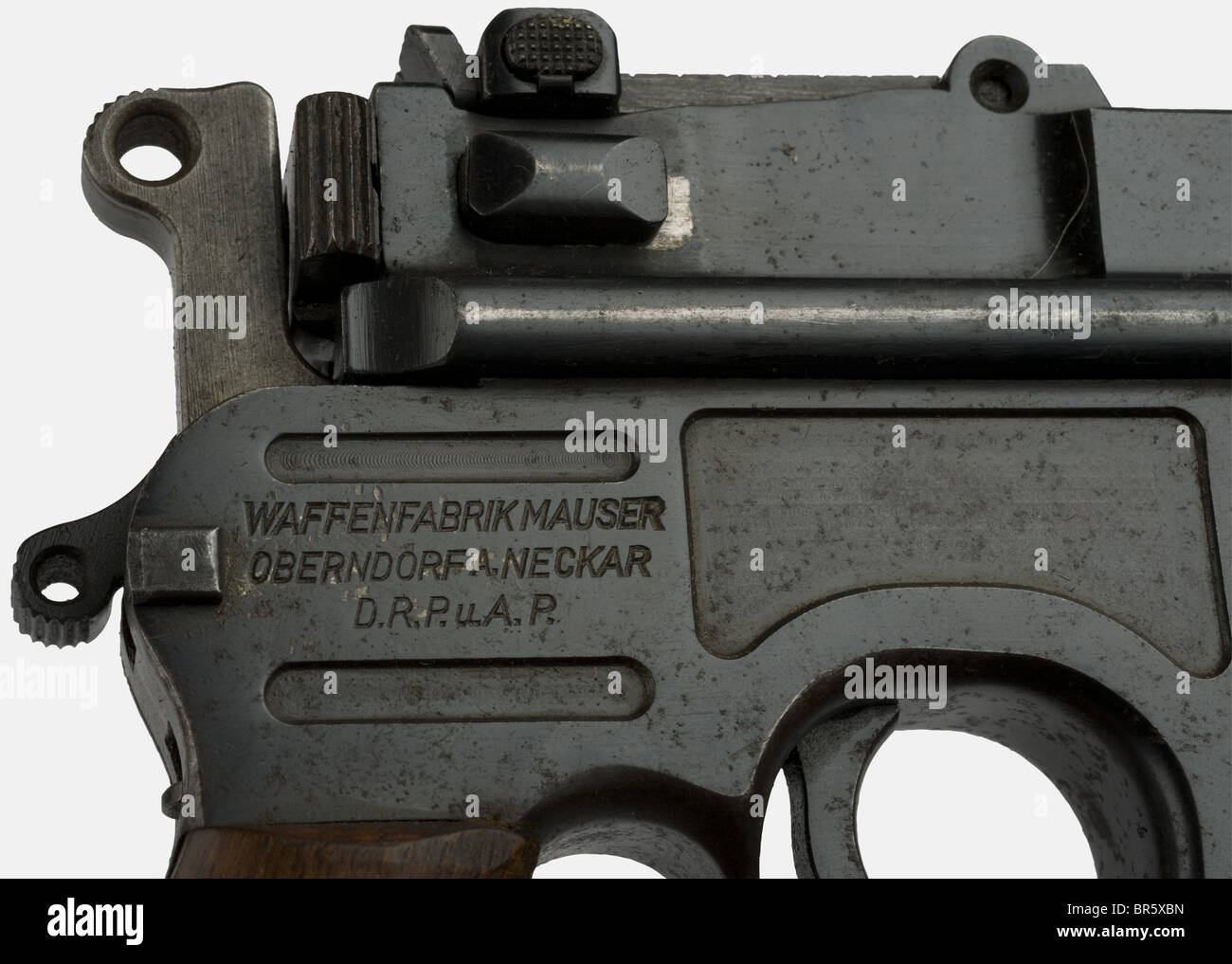
Major variants There were many variants of the C96 besides the standard commercial model; the most common are detailed below. M1896 Kavallerie Karabiner One of the experimental ideas was the creation of a pistol-carbine for use by light cavalry. They had a 'slab-sided' receiver, standard 10-round magazine, a permanently affixed wooden stock and forend, and a lengthened 300 millimetres (12 in) (early production) or 370 millimetres (15 in) (late production) barrel. They were dropped from production after 1899 due to poor sales and little military interest. There was limited sporting interest in the carbine version and due to small production numbers it is a highly prized collectible priced at about twice the value of the pistol version. Recently, importers like Navy Arms imported late-model Mauser carbines with 16-inch or longer barrels for sale in the US. M1896 compact Mauser A version of the Mauser pistol with a full-sized grip, six-shot internal magazine, and a 120-millimetre (4.7 in) barrel.
Production was phased out by 1899. M1896 officer's model This is the unofficial term for a variant compact Mauser with a curved wooden or hard-rubber grip, like that of a. The name comes from the US Army designation of the Mauser pistol sent to participate in their self-loading pistol trials. M1898 pistol carbine This is the first model to come cut for a combination wooden stock-holster.
The stock doubled as a case or holster and attached to a slot cut in the grip frame. M1912 Mauser export model This model was the first to chamber the export cartridge. It was designed to appeal to the arms markets in South America and China. Mauser C96 pistols in this caliber usually have an indentation milled into the upper surface of the magazine's follower to facilitate feeding of the straight-cased 9×25mm cartridge cases. The rifling in the barrel has a unique 13:8 twist. In addition, the flat surfaces extending around the chamber are longer to accommodate the higher pressures of the 9×25mm cartridge. Examples of Mauser C96s in this caliber are rare, but are still occasionally found on the private collector's market.
The 9×25mm Mauser export caliber receded from the market as the armaments industry reoriented itself towards military manufacture during World War I, but the round enjoyed a resurgence in popularity as a submachine gun caliber in the 1930s. M1920 Mauser rework The (signed in 1919) imposed a number of restrictions on pistol barrel lengths and calibres on German arms manufacturers.
Pistols for German government issue or domestic market sales could not have a barrel longer than 4 inches and could not be chambered for 9 mm cartridges. The banned the private ownership of military-issue or military-style weapons in an attempt to recover valuable arms from returning soldiers. The confiscated weapons were then used to arm government forces, leaving them with a hodge-podge of military and civilian arms. To meet the conditions of the Treaty of Versailles, a major reworking project was begun that set about converting these weapons. To be compliant, pre-war C.96 models belonging to the Weimar government had to have their barrels cut down to 99 millimetres (3.9 in). This meant that their tangent sights had to be replaced with fixed sights.
They also had to be converted to the standard 7.63×25mm Mauser round, though a few hybrid Mausers were made with salvaged Luger barrels that were chambered for. Compliant confiscated government-issue guns were marked M1920. This practice was continued on German service pistols even after the ban was ignored and the conversions had stopped. M1921 'Bolo' Mauser Mauser began manufacturing a compliant version of the C96 for commercial sale from 1920 to 1921. It featured smaller grips, a shorter 99-millimetre (3.9 in) barrel, and was chambered for the standard 7.63×25mm Mauser.
An experimental 8.15×25.2mm Mauser cartridge was used to replace the banned 9×19mm Parabellum and 9×25mm Mauser Export cartridges for domestic sales but it never supplanted the 9mm caliber. Mass-production of the weapon was from 1921 to 1930. It was sold in quantity to armies in the contested Baltic region and was carried by the Poles, Lithuanians, German and. The government (and later the new ) of the embryonic Soviet Union, purchased large numbers of this model in the 1920s and also appropriated them from defeated enemies. The distinctive pistol became associated with the Bolsheviks and was thus nicknamed the 'Bolo'. The 'Bolo' model was also popular elsewhere, as the shorter barrel and smaller overall size made the gun easier to conceal.
There was also a transitional version in 1930 that used the 'Bolo' frame but with a longer 132-millimetre (5.2 in) barrel. M1930 Mauser Also known as the M30 by collectors, it was a simplification and improvement of the M1921 Mauser.
Quick Identification
It simplified production by removing several fine-machining details and reverted to the large grip and long barrel. The early model M30s had a 132 millimetres (5.2 in) barrel, but later models had the traditional 140 millimetres (5.5 in) barrel. It was made from 1930 until 1937. Joseph Nickl designed a selective-fire conversion in 1930.
It tended to 'cook off' (fire by spontaneous ignition of the propellant when overheated) when fired in long bursts. Only 4,000 of this model were made between 1930 and 1931. Since the M1932 / M712 variant was full-auto, the semi-auto M1930 it was derived from was sometimes called the M711 by war surplus dealers and collectors. M1932/M712 Schnellfeuer. Main article: The Spanish gunmaker began producing a copy of the Mauser C.96 in 1927 that was externally similar to the C96 (including the presence of a detachable shoulder stock/holster) but with non-interlocking internal parts. It was produced until 1941, with a production hiatus in 1937 and 1938, and a final batch assembled from spare parts in 1951.
The Spanish copies of the C96 were generally intended for export to China, but after the commencement of the (which blocked supply of guns to Chinese forces) the remaining Astra 900s were used in the, and numbers were also sold to Germany in the period 1940–1943. ETAI / Royal MM31 (Model 1) Produced by Beistegui Hermanos in, Spain, this was the first pseudo-Mauser on the market, a relatively crude semi-auto appearing in 1926 and full-auto variants appearing in 1927. Mechanically, it was laid out approximately like the Mauser original, but without the removable lock frame. Internal parts (trigger, hammer, safety lever, etc.) pivoted on pins and screws extending through the frame. The screws also held the frame together. The bolt was of round cross-section, unlike the square Mauser bolt. The weapon was stamped with either 'Royal' or 'ETAI'.
Royal MM31 (Model 2) This was a much closer copy of the Mauser original than the ETAI/Royal model and variants, with the full separate lock frame and all. It was of much better quality than the earlier gun, though still not at Mauser level. The MM31 was manufactured until 1934. A total of about 10,000 were made, in perhaps four successive variants. These models came in semi-auto and semi-auto/full auto selective fire variants. Royal MM34 This model was much like the MM31, but added a mechanical rate reducer inside the grip area, a three-position lever to select the firing rate.
It also had a ribbed barrel to help prevent the barrel from overheating during sustained full auto fire. Only a few hundred of these weapons were made and are very rare today. Azul and Super Azul The Azul and Super Azul pistols were also manufactured by Beistegui Hermanos in Eibar, Spain, but sold by Eulogio Arostegui. The Azul was a copy of the standard C96 while the Super Azul was a semi auto/full auto select fire variant.
Each accepted detachable box magazines instead of having an internal box magazine. Federal Ordnance M713 and M714 In the late 1980s to the early 1990s, the Federal Ordnance firearms company in South El Monte, U.S.A. Made reproductions of the Mauser 1917 Trench Carbine and C96 pistol, named the M713 and M714 respectively. The M713 came in a standard variant with a fixed stock and magazine, as well as a 'Deluxe' variant which had a detachable stock and detachable box magazines. The M714 supported detachable box magazines, unlike the original C96, and a 'Bolo' variant, with the 'Bolo' model having a shorter barrel and grip. All variants of the M713 and M714 were available in 7.62x25mm and 9x19mm ammunition. Users.: Used in the and in the.: Army issued 137,000 of the 'Red 9' variant during World War I.: 5,000 bought from Germany in 1899 for the navy.: 8,000 of the Schnellfeuer variant was issued to the during World War II.
Mauser C96 Serial Number Lookup
Also bought thousands of the Spanish-made and 903 variants.: 1,000 ordered from Germany in 1896.: Hundreds of thousands were used by, and forces.: 'Bolo' variant bought from Germany during the 1920s.: Many were privately bought by British officers in the period before World War I. Non-state actors. Cultural significance The Broomhandle is a popular collector's gun. It was popularized in Soviet films as the iconic weapon of the Russian revolution and civil war. The C96 frequently appears as a 'foreign' or 'exotic' pistol in a number of films (such as, where 's use of the C96 intentionally contrasts with the revolvers used by the other characters in the film) and TV shows, owing to its distinctive and instantly recognisable shape.
Author outfitted agents of in the series with Mausers on the advice of firearms expert. The C96 was the inspiration for the Buck Rogers Atomic Pistol in the movie serial and the comic, and a popular toy version was produced in 1934 by the Daisy Manufacturing Company. A C96 was modified to form 's prop pistol for the films. Reproductions of the blaster became so popular in the community that gun collectors became aware that fans were buying and altering increasingly rare original Mausers to make blaster replicas. A.45 ACP C/96 was also fictional character 's main weapon in the 1983 comic book. See also.
– a similar German designed semi-automatic pistol produced under license in Belgium.